Research

I work on seismic protection and vibration control, from passive devices that dissipate earthquake energy to steel sections that resist buckling and impact. Material behaviour comes from the laboratory, and a numerical model is only as useful as the experiment it can reproduce.

Research areas

Research and experimental work

1. Passive vibration control devices

Department of Structures for Engineering and Architecture, University of Naples Federico II, 2024–2026

Seismic protection strategies for underground tunnels, developed within a national research project funded by the European Union through NextGenerationEU. The emphasis is on eco-friendly solutions: low-impact, resource-efficient devices for underground infrastructure. The work covers constitutive and hysteretic modelling of passive energy-dissipating and isolation devices, and their use in nonlinear dynamic analysis.

Funding
PRIN 2022 PNRR project P2022ZT5X5, Smart Under-Ground Infra-Structures for Secure Communities and Post-Disaster Emergency Response: Eco-Friendly Seismic Protection Solutions.
Force–displacement loops of a hysteretic damper Three loops for displacement amplitudes of 10, 20 and 30 millimetres. Force reaches about 52 kilonewtons at 30 millimetres. The area inside the largest loop is shaded. -30-20-10102030 -40-202040 Displacement (mm) Force (kN) Energy dissipatedper cycle
Hysteresis loops of a damper cycled to 10, 20 and 30 mm, from a Bouc–Wen model. The shaded area is the energy dissipated in one cycle.

2. Functionally graded materials (FGM)

JAM Lab, IIT Madras, 2021–2024

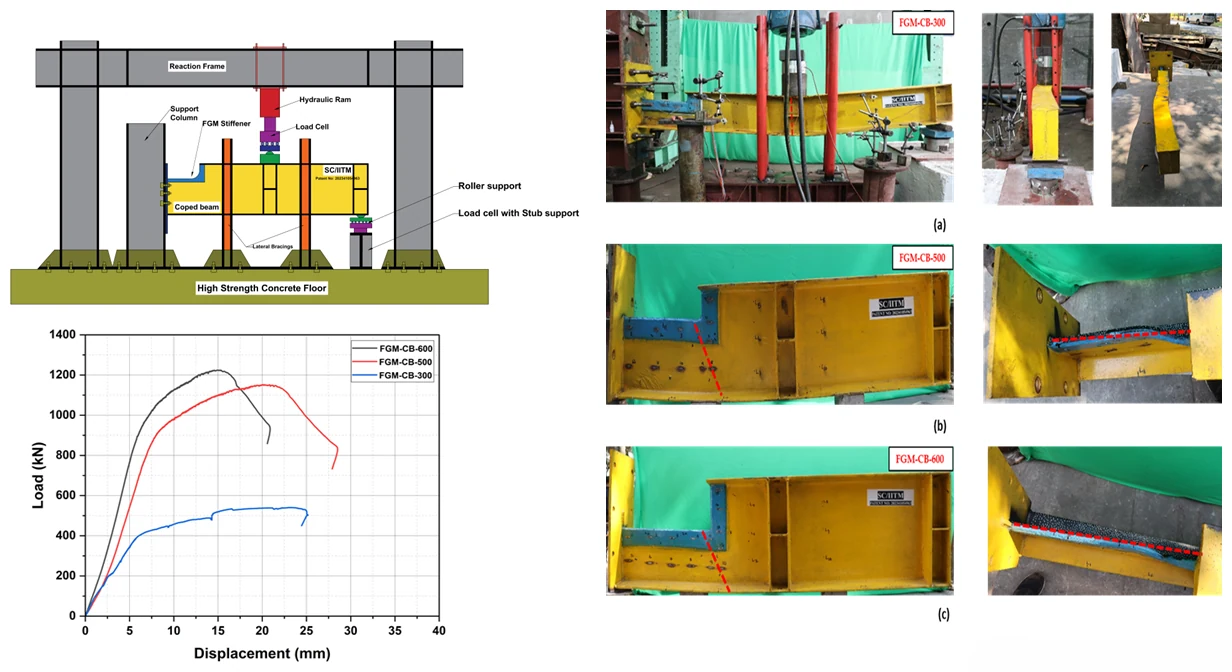
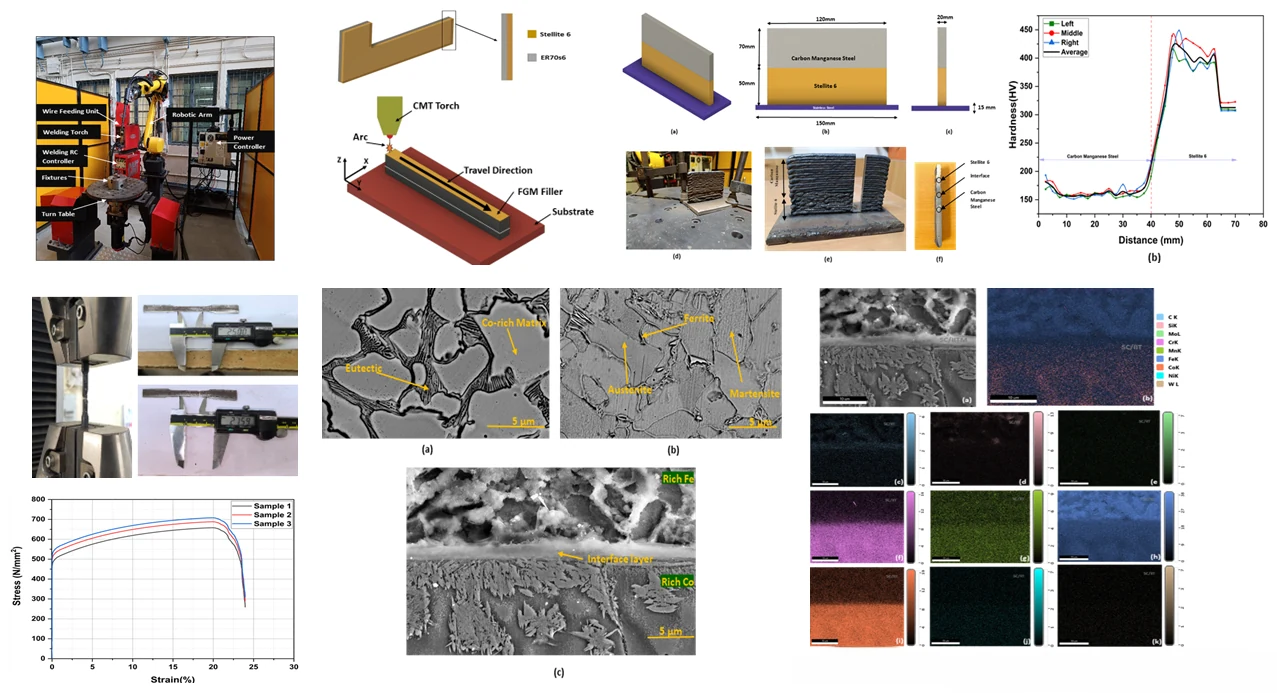
The bearing plate of the coped-beam stiffener was made by wire arc additive manufacturing (WAAM) as a functionally graded material, grading carbon-manganese steel into Stellite 6. Its microstructure was characterised down to individual grains, and its strength, corrosion resistance and fracture mechanism were studied alongside those of the constituent alloys.

  • The graded material reached an ultimate tensile strength of 720 MPa.
Robotic WAAM cell, deposition of the graded wall, hardness profile, tensile tests and electron micrographs of the graded steel Enlarge
Wire arc additive manufacturing: robotic deposition cell, the graded wall from carbon-manganese steel to Stellite 6, hardness across the interface, tensile tests, and microstructure with element maps.

3. Coped beam testing with DIC

Structural Engineering Laboratory, IIT Madras, 2021–2024

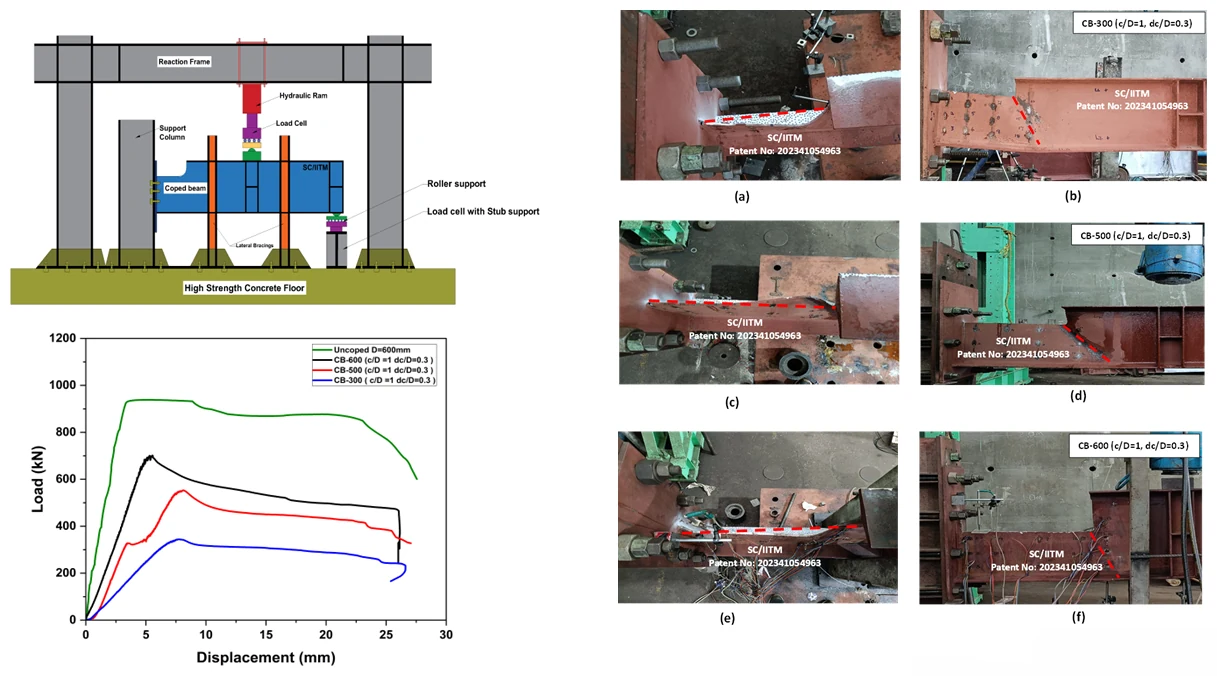
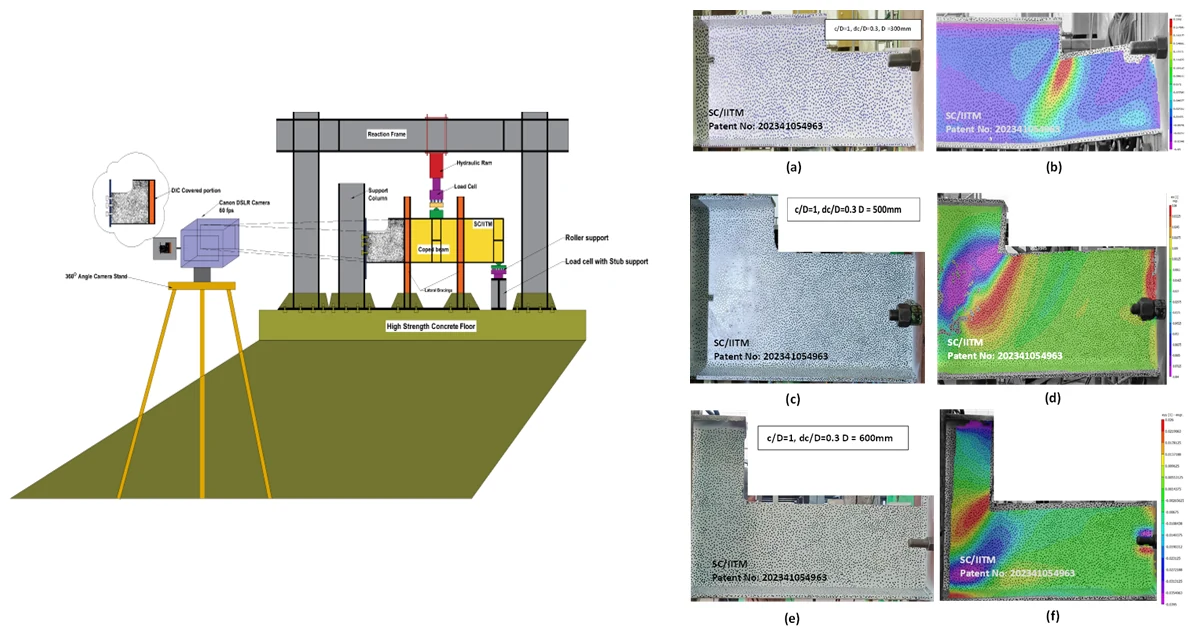
Steel coped beams in industrial structures carry clusters of water mains, fire hydrants, power cables and telecom lines. A new coped beam for offshore topsides was tested to failure, with digital image correlation (DIC) recording the strain field at the cope, and a finite element model was built and validated against the results. Buckling behaviour and failure patterns were studied in detail.

  • Digital image correlation is proposed as an effective tool for the structural assessment of steel coped beams.
Test set-up, load–displacement curves and six photographs of failed conventional coped beams Enlarge
Conventional coped beams: test set-up, load–displacement response of CB-300, CB-500 and CB-600 against an uncoped 600 mm beam, and failure at the cope (a–f).
Test set-up with the FGM stiffener, load–displacement curves and photographs of FGM-stiffened coped beams after testing Enlarge
FGM-stiffened coped beams: test set-up with the graded stiffener at the cope, load–displacement response of FGM-CB-300, FGM-CB-500 and FGM-CB-600, and the specimens after testing.
Digital image correlation set-up and speckle patterns with measured strain fields for three coped beams Enlarge
Digital image correlation: camera set-up, and the speckle pattern with the measured strain field at the cope for beams 300, 500 and 600 mm deep.

4. Impact behaviour of coped beams

Department of Ocean Engineering, IIT Madras, 2021–2024

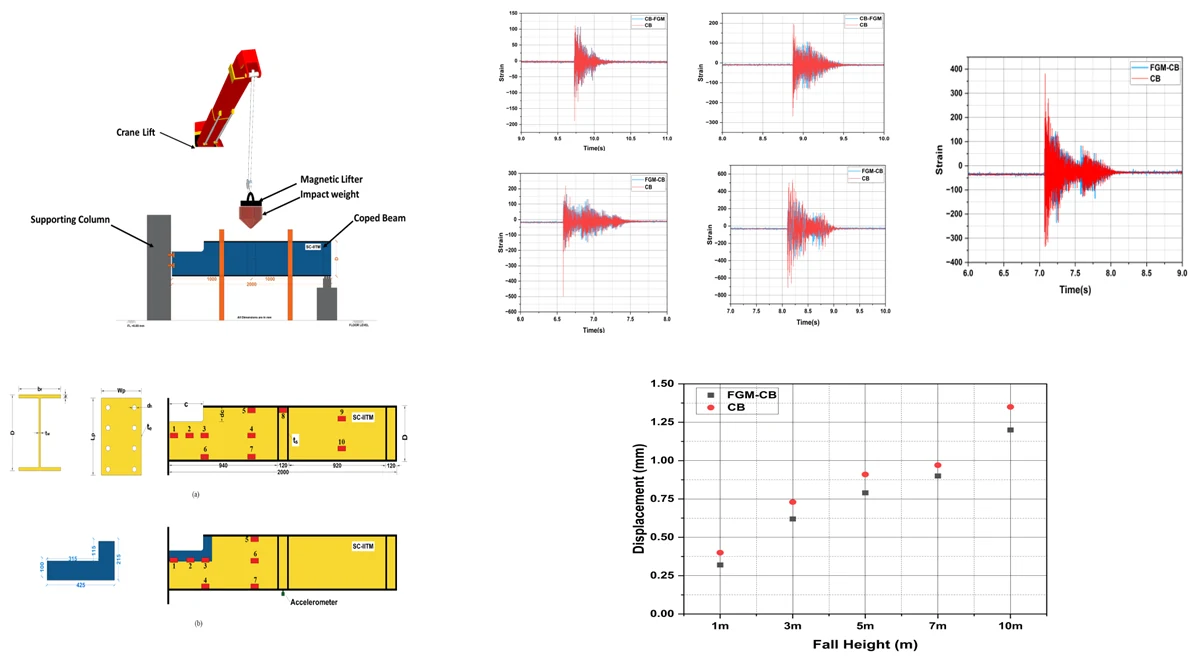
Drop-weight impact tests on steel and FGM-stiffened coped beams from heights of 1, 3, 5, 7 and 10 m, with strains and displacements recorded throughout.

  • The cope corner and the impact region were the most vulnerable, with the highest strains and displacements.
  • The FGM stiffener significantly reduced strains and displacements in the cope region.
Drop-weight impact set-up, strain gauge layout, strain time histories and a chart of displacement against fall height Enlarge
Drop-weight impact tests: set-up and strain-gauge and accelerometer layout, strain histories of steel (CB) and FGM-stiffened (FGM-CB) beams, and displacement at each fall height.

Methods and tools

  • ABAQUS
  • OpenSees
  • MATLAB
  • Digital image correlation
  • Strain gauges and accelerometers
  • Servo-hydraulic static and fatigue testing
  • Drop-weight impact testing
  • Shake-table testing
  • Wire arc additive manufacturing
  • Autodesk Fusion

Design codes

  • IS 1893
  • ASCE 7
  • Eurocode 8